Archive / GRETA Journal — 2002, Volume 10, Number 2
Published in: GRETA Journal — 2002, Volume 10, Number 2
Type: Article
Cite this item
Isabel Pérez Torres; María del Mar Sánchez Ramos. (2002). Fostering vocabulary acquisition through self-learning tools and electronic dictionaries. GRETA Journal, 10(2). https://gretajournal.com/archive-v10-n2-2002-fostering-vocabulary-acquisition-through-self-learning-tools-and/
Full text
FOSTERING
VOCABULARY ACQUISITION THROUGH SELF-LEARNING TOOLS AND ELECTRONIC DICTIONARIES
Isabel Pérez
Torres & Mª del Mar Sánchez Ramos
It is important to accept that CALL can genuinely lead to autonomy,
to a state in which learners exercise as much control as possible over
the learning process and are as little dependent on the teacher as possible
(Jones 2001)
INTRODUCTION
The acquisition of vocabulary occupies a key position in learning a second
language. As teachers of English we should offer a fairly wide range of
possibilities in order to improve and reinforce lexical competence. It
is also evident that New Technologies offer a great number of resources
for the English classroom. Thus, several studies (Al-Seghayer 2001; Aust
1993; Chun & Plass 1996) have proved that CALL and multimedia environments
are really helpful in order to learn vocabulary. At this point it seems
necessary to know how to integrate multimedia materials to increase lexical
competence.
This paper will demonstrate
how to use two interactive tools in the English classroom. On the one
hand, we will use electronic dictionaries. Though traditionally viewed
as a demotivated resource, dictionaries are one of the most valuable vocabulary
strategies. In fact, they offer all the linguistic information a student
needs to understand words. On the other hand, we will work with one specific
authoring tool called Hot Potatoes. This resource allows teachers to design
activities without being particularly skilful in computers. In short,
our proposal is to connect both tools and show a sample of activities
to be developed in a multimedia environment, which will promote learner
autonomy and increase learner motivation.
THE IMPORTANCE OF TEACHING
AND LEARNING VOCABULARY
Lexical competence is an
important aspect in English Language Teaching-ELT. Nevertheless, vocabulary
has not been systematically taught in the English classroom and therefore
lexical aspects have been undervalued and subordinated to the study of
grammatical structures (Nation 1998). Everybody would agree that words
are essential components when learning a second language-L2. One of the
main principles in EFL is that the number of words will delimit the understanding
of a L2. Taking into account this last statement, different researchers
(Laufer 1997; Nation 2000) warn about the importance of acquiring a minimum
of vocabulary so that students can understand a text. We can take Laufer
(1997:20) as an example. She states that “no text comprehension is
possible, either in one’s native language or in a foreign language, without
understanding the text’s vocabulary”. The aim of her research is
to establish the close relation between the level of vocabulary and reading.
Briefly, her final results set about 5,000 words in order to understand
98% of a text. D. Hirsh and P. Nation (1992) obtain similar conclusions.
They propose an approximate number of 2,000-3,000 words to ensure the
comprehension of texts.
Although most methods devoted
to Bachillerato pay great attention to the study of vocabulary, when it
comes to practice it has been an abandoned aspect in favour of the study
of syntax and other language aspects. This is due, mostly, to the relatively
minor importance of the lexical section in the university entry exams
in our country. In spite of this, teachers should offer opportunities
of achieving a minimum of vocabulary.
ELECTRONIC DICTIONARIES
(ELDS) AS STRATEGIES TO LEARN VOCABULARY
When we revise ELT syllabuses
from a lexical perspective, one of the general aims is the development
of learner autonomy. Therefore, as teachers, we should assure that students
are aware of the importance of guiding their own learning in a L2 and,
particularly, their own lexical learning. In order to develop this learner
autonomy A. Hunt and D. Beglar (1998) present two well-known strategies
related to vocabulary:
a) Experiment with guessing from context.
b) Examine different types of dictionaries and teach students how to use
them.
In the present article we
pay specific attention to the latter strategy. On the one hand, dictionaries
are an extremely important vocabulary strategy, although they have been
almost neglected in the English classroom. A dictionary is like a “big
answer”: it offers the solution to a great number of our students’
questions about words. It will be beyond the scope of this article to
explain all the information a dictionary offers, but in general terms,
we can point out that this reference material provides morphological,
syntactic, semantic, lexical, and, finally, pragmatic information (Rizo
Rodriguez, 1991:112-125). On the other hand, dictionaries are tools for
autonomous learning. According to T. Herbst and G. Stain (1987:125), dictionaries
are a tool of achievement control [ ]. The dictionary is an institution
which enables language learners to check their own knowledge, and to eliminate
weaknesses in spelling, pronunciation, grammar and meaning [ ]. The
dictionary is a tool that will wean learners away from the classroom teacher
and guide them towards further independent study.
Taking into consideration
the needs and level of students of Bachillerato, in this article we will
deal with bilingual dictionaries, as this type of dictionaries are useful
at low-intermediate level. In support of this selection, we can refer
to a study by S. Luppescu & R.R.Day (1993:263). They focus on the
relation between vocabulary acquisition and the use of bilingual dictionaries
during reading. Their final results show that “students who use a
dictionary scored significantly better on a vocabulary test that students
who do not use a dictionary”. Taking a similar starting point of
departure, S. Knight (1994) tries to establish dictionary use in two different
groups: those with lower verbal ability in the target language and those
with higher verbal ability. Final results corroborate that there was a
significant improvement in levels of reading comprehension for students
who use a dictionary. “Subjects who used the dictionary not only
learned more words but also achieved higher reading comprehension scores
than those who guessed form context” (Knight 1994:295). The research
concludes that bilingual dictionary use should be encouraged for students
of low verbal ability, for whom guessing the meaning of a word from context
can be a difficult task.
Up to this point, it is worth
noting that new types of reference material have appeared in the last
few years. Thus, along with traditional printed dictionaries, we can also
find electronic dictionaries-ELDs- and the so-called online dictionaries.
ELDs offer a wide range of possibilities for the EFL classroom and can
be effectively integrated with CALL activities. This type of reference
material offers the same information as printed dictionaries, but it differs
in terms of accessibility. Generally speaking, we can highlight some features
regarding English electronic dictionaries (Perez Torres & Sánchez
Ramos 2002):
a) Interactivity. It clearly
implies students´ involvement.
b) Hypertextuality. It is related to the structure of the dictionary.
All the information is interconnected and the student can get access
to the information just clicking a key.
c) Quick access. ELDs` accessibility allows a user friendly search and
lexical units can be found more easily.
d) Multimedia effects. While design in printed dictionaries is related
to letter size and type as well as page layout, ELDs make the most of
colour, movement, sound and the use of icons that take the student to
different sources of information. Some ELDs have the facility of listening
to the pronunciation of a word. Sound could be very useful to learn
certain words (eg. whistle).
e) Extra features. ELDs contain many other extra features which cannot
be found in printed dictionaries, such as video and audio material,
corpus examples and interactive exercises and games.
In addition, it has been proved that ELDs increase the potential of
learning and motivate students to know more about English (Pérez
Torres 2002:68).
Despite all the features
described above, ELDs are still under-used and under-exploited in the
English classroom. As we will comment later on, it is still very difficult
to integrate them into our English classrooms, along with other CALL resources.
OXFORD STUDY DICTIONARY
To put into practice the
activities that we will present later on, we have chosen one of the bilingual
dictionaries currently available in the market: Oxford Study Dictionary/
Diccionario Oxford Study Interactivo para estudiantes de inglés.
Taking into account the general level of students of bachillerato, Oxford
Study Dictionary seems one of the best options. To start with, it is suitable
for Spanish students at an intermediate to advanced level, which is the
one expected for our students of bachillerato. This interactive dictionary
encompasses the full text of its printed counterpart, plus other additional
features. In short, we can underline the following features:
– Hyper linked entries,
clearly offering a quick and easy access to other related entries.
– Hundreds of useful grammar notes and a large number of idiomatic expressions.
– Option of listening to the words, as well as recording one’s own pronunciation.
– Images, appendixes and maps. Multimedia features, such as videos to
reinforce vocabulary.
– Interactive exercises to work on use of English, vocabulary and reading
comprehension, language learning games (crosswords, phrase finder, memory,
and phrase blaster).
Another interesting point
is the user-friendly design and practical format. As a final remark, we
consider that the use of interactive dictionaries, such as the one we
have used to work with our students, not only contributes to the acquisition
and reinforcement of vocabulary but also to the promotion of learner autonomy.
AUTHORING PROGRAMS
Our proposal for improving
lexical competence involves the use of a second computer learning tool:
the authoring program Hot Potatoes. The activities we have designed consist
of using the electronic dictionary as a strategy for learning vocabulary
in combination with interactive exercises created with an authoring program;
in doing so the students are impelled to use the dictionary in order to
answer the quizzes and exercises accurately. Authoring programs allow
teachers to create interactive exercises specially designed for their
classes without any need to be very skilful with computers. In the last
decades several authoring tools have been developed in support of educational
projects that had the intention of introducing computers as a teaching/learning
tool in the classroom without being restricted to close software, like
multimedia CD-Roms, and without any knowledge of computer programming.
One of the tools that has become increasingly popular among second language
teachers is Hot Potatoes. This is a software suite that comprises the
following six programs:
– JBC to create multiple
choice quizzes.
– JQuiz for short-answer quizzes.
– JMix for jumbled-sentences exercises.
– JCross to create crosswords.
– JMatch for matching exercises.
– JCloze for gap-filling exercises
In comparison with other
authoring programs, Hot Potatoes is not just a testing tool, but a self-access
learning tool that allows teachers to include feedback prompts to guide
students in wrong answers or add useful information when the answer is
correct. There are other characteristics that recommend the use of this
program. We will summarise them following what M. Holmes and S. Arneil
explained about the development of Hot Potatoes (2002).
a) The programs present an easy interface for beginner users:
– Data are entered in the main window by typing the questions and answers
or also by copying and pasting them from a word processor document.
It also allows inserting pictures and sounds.
– There is a configuration window where authors can set instructions,
colours, button captions, etc. easily.
b) The resulting exercises are web pages that are displayed on standard
browsers, such as Netscape and Explorer. This is a great advantage that
encourages use, since both browsers are freeware and usually installed
on computers. The exercises can be changed or corrected later on, as
each of the six programs create a Hot Potatoes format file that may
be transformed afterwards.
c) Having a web page format does not mean that we need to host the exercises
on a web site. We neither need to work online. The only requirement
is opening the exercises with a browser, such as Netscape or Explorer.
d) License terms permit free use and sharing of the software and materials
among the academic community, so that anyone can download and use the
program for free if it is for non-profit educational purposes .
From a pedagogical perspective
the main reason for using this program suite is that it is an excellent
self-learning tool. It helps students test their lexical knowledge and
encourages them to take control of their own learning process, which indirectly
increases motivation. This way, using both learning tools, electronic
dictionaries and self-evaluating Hot Potatoes exercises, the students
go through a reversible path autonomously: do the exercise to use the
dictionary and use the dictionary to complete the exercise.
We have used Hot Potatoes
to design activities applied to vocabulary learning, but, obviously, it
is suitable for many other language aspects. Besides, although Hot Potatoes
was initially designed for language teaching, it has been used for a wide
range of different subject areas and at levels from elementary school
to university (Holmes & Arneil :2002).
LEARNING A LANGUAGE AUTONOMOUSLY
AND MOTIVATION
According to research there
is evidence that learners’ active and independent involvement in their
own learning autonomy increases motivation to learn and consequently increases
learning effectiveness (Dickinson 1995:165). Both steps in the activities
proposed in this paper, using electronic dictionaries and doing Hot Potatoes
quizzes are autonomy and self-assessment strategies. The students can
decide when to use the dictionary and the exercises are self-checked and
can be done, as many times as they want, till they are completely correct.
This self-evaluation feature, as well as the feedback provided by the
quizzes and dictionary entries, helps students to understand that they
are in control of their own learning if they decide to take advantage
of the information offered by the software. This idea, together with the
fact of perceiving that their learning successes or failures depend on
their own efforts and strategies are characteristics of learner autonomy
as described in applied linguistics (Dickinson 1995:174).
Being an autonomous learner does not mean that the students learn alone.
In fact, as P. Nation states (Nation 1998:17), teachers should help learners
foster the three factors that autonomy relies on, attitude, awareness
and capability. He establishes a set of learning principles that will
help in the process of taking control of vocabulary learning. We have
taken these into account when designing the activities with the authoring
tool Hot Potatoes. However, we would like to underline the eighth principle,
which refers to monitoring and assessment, “learners should be aware
of and excited by their progress in vocabulary learning” (Nation
1998:16). We consider that the activities we propose provide an opportunity
to apply this principle, as the learner monitors his own progress, being
able to fulfil the exercise successfully. Furthermore, in our experience,
using computers in language learning has been proved to be a motivating
factor among teenagers due to the fact that it increases attention and,
consequently, effectiveness is enhanced. Of course, the task has to be
well monitored by the teacher. Working with computers requires the teacher
and the students to develop some computer skills and new learning strategies,
but it is worthwhile investing some effort in it, as the results can be
remarkable.
SAMPLE ACTIVITES CREATED
WITH HOTPOTATOES TO IMPROVE VOCABULARY ACQUISITION
The group of activities proposed
has two general aims: to increase vocabulary in the level of bachillerato
and make students aware of the value of using dictionaries as a strategy
to learn and understand words better. Throughout the activities, students
will realise how a dictionary helps learners with word formation, pronunciation,
collocations, use, etc. by means of informative notes (morphology, phonetic
transcription, grammar, sound, register, use) and contextualised examples
(idiomatic expressions, sentences, images, videos). Therefore, after doing
the exercises, students will have improved their vocabulary and dictionary
skills.
In order to fulfil these goals, we have created a taxonomy of tasks which
are focused on the three main aspects pointed out by P. Nation (2000:26)
when he establishes what is involved in knowing a word: form, meaning
and use. In doing so, we have designed nine different activities covering
the following aspects.
FORM
1) Working with word families
Items: aimless, attraction, encouragingly, astonishment, fear,
die, alive, profitable, conclusively, disturb.
Specific aims:
to work with some of the most common suffixes. To make students aware
of the importance of knowing those suffixes in order to classify words
(nouns, verbs, adjectives, and adverbs)
Activity: this
is a gap-filling exercise. The student has to complete the table with
the correct form of the item for each function: noun, verb, adjective,
and adverb.
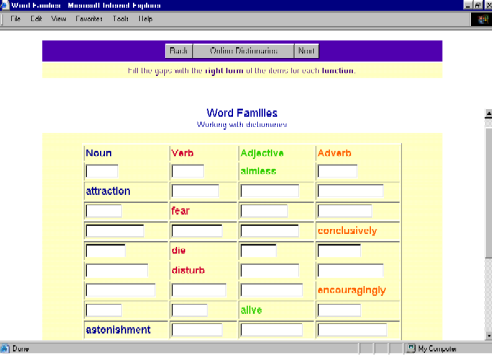
Image 1
2) Word formation: Prefixes
Items: unfair, unaware,
unclear, impolite, indirect, impossible, independent, immature, inconvenient,
illegal, illiterate
Specific aims: to work with the most common prefixes in English.
To help students learn when they can use each of them.
Activity: this
is a gap-filling exercise. The students have to choose the right prefix
for each word and fill in the gaps in the contextualised sentences.
3) Working with sounds
Items: hut, hot; luck,
lock; cuff, cough; gun, gone; colour, collar; wonder, wander.
Specific aims: to
practise sound-contrast between à and . To make students
aware of the differences between these two sounds and some of their common
spelling.
Activity: this
is a multiple-choice quiz. Students have to decide which of both sounds
is pronounced in each case. They have to check the phonetics transcription
in the dictionary as well as to listen to the word.
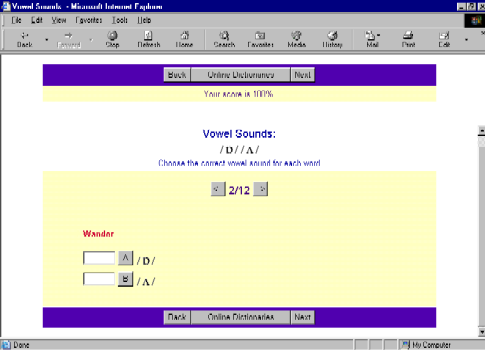
Image 2
MEANING:
4) Recognising false friends
Items: actually,
fabric, realise, eventually, sensible, spectacles, idiom, career, notes,
succeed.
Specific aims:
to work with false friends, usually cognates sharing form with Spanish
words but not meaning. To help students avoid mistakes.
Activity: this
is a contextualised multiple-choice quiz. The students have to choose
the right translation for the underlined item in each sentence.
5) Learning some common
phrasal verbs
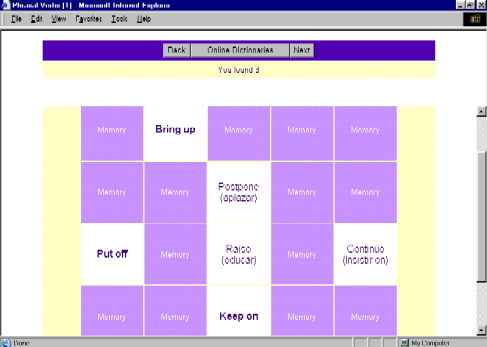
Image 3
Items: bring up, find out, give away, keep on, put off, put up
with, take off, look forward to, break down, get over.
Specific aims: to learn the meaning of some common phrasal verbs.
To understand what information dictionaries include about phrasal verbs.
Activity: this activity consists of a non-contextualised memory-matching
quiz. The students have to match some phrasal verbs in English with their
meaning in Spanish.
6) Understanding confusing
words
Items: advise/advice;
beside/besides; dessert/desert; lose/loose; feel/fill; whether/weather;
all/whole; alone/lonely; waiting/expecting; accept/except.
Specific aims: to understand differences among commonly confused
words. To understand that words may be confusing because of many factors:
sound, form, meaning, etc.
Activity: this is a short-answer quiz in context. The students
have to write the correct word to substitute the gap in each sentence.
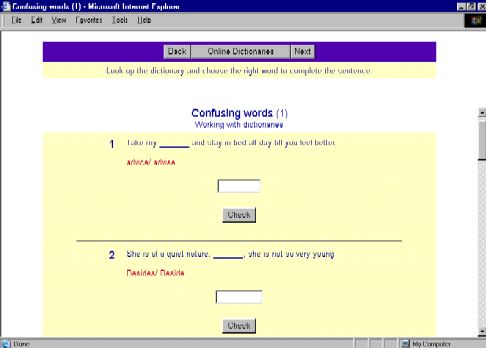
Image 4
USE
7) Working with prepositions
Items: rely on, scared
of, interested in, enthusiastic about, take advantage of, amount of, risk
to, fall in love with, deal with, laugh at.
Specific aims: to learn that prepositions translate differently
in Spanish, depending on the word in front of them. To learn that, in
most cases, words accompanied by prepositions should be learnt as a whole
item.
Activity: this is a matching exercise. The students have to match
the noun, adjective or verb with the correct preposition.
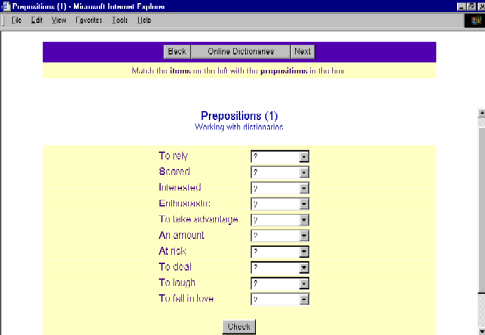
Image 5
8) Learning uses of make/do
Items: make an effort,
make your bed, do a favour, make a living, do the exercise, make friends,
do your work, do business, make an arrangement, make a cake, make a fuss,
do the washing up, make a choice, make sense, do some shopping
Specific aims: to make students aware of lexical collocations and
how dictionaries can be used to learn about them.
Activity: this is a gap-filling exercise where the students have
to complete the sentence with make or do, after looking up in the dictionary.
9) Distinguishing British
and American English
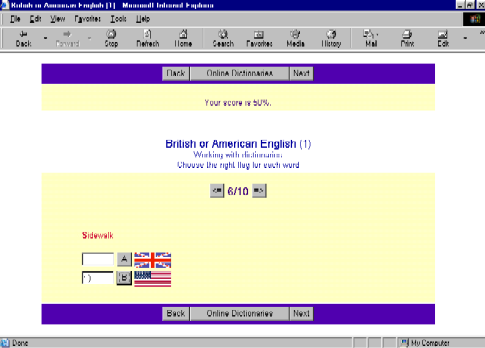
Image 6
Items: candy, biscuit,
film, chips, crisps, sidewalk, lorry, vacation, cheque, note.
Specific aims: to identify dialectal differences and how they are
shown in the dictionary.
Activity: this is a multiple-choice exercise. The students have
to decide if the words are used in American or in British English.
As we said previously, it
is not necessary to host these activities on the Web to be implemented
by the students, as they can be carried out off-line. However, in case
you would like to see how they work, they are hosted at the following
address http://www.isabelperez.com/dictionaries.htm
CONCLUSIÓN
To conclude, we may well
admit it is possible to promote learner autonomy and self-assessment in
a multimedia environment. Both electronic dictionaries and authoring programs
offer a new way to improve and reinforce vocabulary if used appropriately.
Our aim in this article has been to analyse the main features of these
two resources and, finally, to show how we can integrate them in a multimedia
environment to improve lexical acquisition.
REFERENCES
Al-Seghayer, K. 2001. “The
effects of multimedia annotation modes on L2 vocabulary acquisition: A
comparative study”. Language Learning and Technology 5/1: 202-232.
http://llt.msu.edu/vol5num1/alseghayer/. (January 14, 2003).
Aust, R., Kelley, M. J., & Roby W. 1993. “The use of hyper-reference
and conventional dictionaries”. Educational Technology Research and
Development 41: 63-73.
Chun, D. M., & Plass. J. L. 1996. “Effects of multimedia annotations
on vocabulary acquisition”. Modern Language Journal 80/2: 183-212.
Dickinson, L. 1995 “Autonomy and motivation: a literature review”.
System 23/2: 165-174.
Herbst, T. y Stein G. 1987. “Dictionary-using skills: a plea for
a new orientation in language teaching. The dictionary and the Language
Learner.. Ed. A. Cowie. Tübingen: M. Niemeyer. 115-127.
Hirsh, D. y Nation, P. 1992. “What vocabulary size is needed to read
simplified texts for pleasure?”. Reading in a Foreign Language 8/2:
689-96.
Holmes, M & Arneil, S. 2002.”The development of Hotpotatoes”.
TELL&CALL, http://www.e-lisa.at/magazine/tellcall/1_02pdf/06.pdf (January
5, 2003).
Hunt, A & Beglar, D. 1998. “Current research and practice in
teaching vocabulary”. The Language Teacher . http://langue.hyper.chubu.ac.jp/jalt/pub/tlt/98/jan/hunt.html
(January 3, 2003).
Jones, J. 2001. CALL and the Teacher’s Role in Promoting Learner Autonomy.
CALL-EJ Online, 3/1. http://www.clec.ritsumei.ac.jp/english/callejonline/6-1/jones.html.
(January 6, 2003).
Knight, S. 1994. “Dictionary use while reading. The effects on comprehension
and vocabulary acquisition for students of different verbal abilities”.
The Modern Language Journal 78/3: 285-299.
Laufer, B. 1997. “The lexical plight in second language reading:
Words you don’t know, words you think you know, and words you can guess”.
Second Language Vocabulary Acquisition. Ed J. Coady & T.
Huckin . Norwood, New Jersey: Ablex Publishing Corporation. 5-19
Luppescu, S y Day, R.R. 1993. “Reading, Dictionaries and Vocabulary
Learning”. Language Learning 43/2: 263-287.
Nation, P. 1998. “Helping learners take control of their vocabulary
learning”. GRETA 6/1: 9-18.
Nation, P. 2000. Learning vocabulary in another language. Cambridge: Cambridge
University Press
Pérez Torres, I & Sánchez Ramos, M . En prensa. “Los
diccionarios electrónicos y las bases de datos léxicas en
TESL” en Actas del congreso V Jornadas de Estudios Ingleses A World
of English, A World of translation.
Pérez Torres, I. 2002. “Accelerated Learning Strategies in
a Computer Assisted Language Learning Environment”. GRETA. 9/2: 64-72.
Rizo Rodriguez, A. 1991. “Diccionarios de aprendizaje monolingües
y bilingües del inglés: un estudio comparativo”. Silvia
Nath. In memoriam. Ed I. McCandless Granada: Servicio de Publicaciones
de la Universidad. 105-129.